Open · 22 cm · 21 days to establish
Succulent Gravel Coupe: Drought Logic in an Open Bowl
This is the terrarium for people who overwater. Everything about the build is designed to make water leave fast — grit instead of soil, a shallow unglazed coupe, and a decorative top dressing that keeps the crown of each rosette bone dry. It is the anti-moss build of this collection, and it works on exactly the opposite principles.
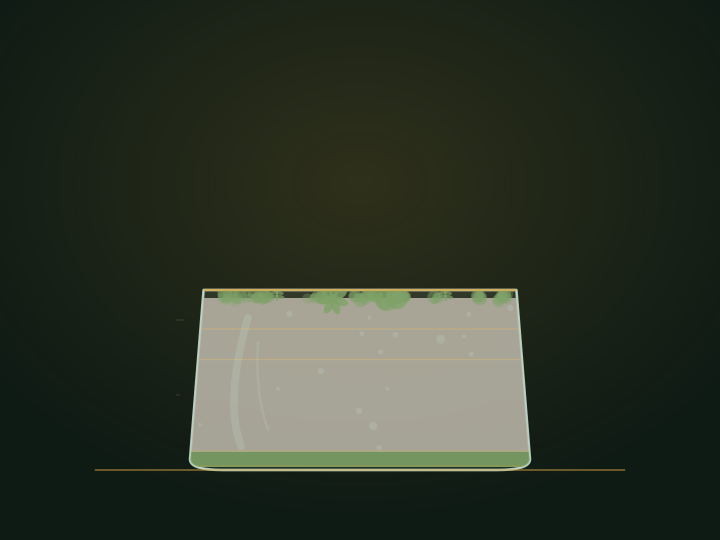
Stratum by stratum
- Drainage: 2 cm coarse grit (6 mm) with no fines
- Filter: none — grit doubles as the root zone base
- Substrate: 6 cm mineral mix (2 parts grit : 1 part compost)
- Cap: 1 cm decorative granite chips
- Container form
- Opencoupe
- Settled height
- 22 cm
- Working volume
- 1.8 L
- Light demand
- Bright, indirect
- Humidity band
- Low
- Difficulty
- Beginner
- Days to establish
- 21 days
Stratum by stratum
-
Open grit base
2 cm of coarse 6 mm grit, no fines. Unlike a moss terrarium, there is no charcoal layer here — in a dry open bowl charcoal accomplishes nothing and just occupies root space.
-
Mineral substrate
Two parts grit to one part compost, 6 cm deep. Succulent roots want air between the grains more than they want organic matter; a rich mix in a shallow bowl is how root rot starts.
-
Rosette placement
Set Echeveria off-centre at the front, haworthia behind it against the rim, and sedum to the side where it can spill. Keep every crown level with or above the rim.
-
Top dressing
1 cm of granite chips, worked in around each rosette with a soft brush. This is not decoration alone — it keeps the lower leaves off wet substrate, which is where black spot begins.
-
Trailing accent
Plant prostrate rosemary at the back edge so it cascades over the rim. Water the whole bowl from the spout at the rim, never over the rosettes, until it runs through.
Growing on
Echeveria needs the brightest spot you have and will stretch into a pale cone if it does not get it. Haworthia is the opposite — it wants bright but filtered light and will scorch red-brown in full summer sun. Both are far more tolerant of a missed watering than of an extra one. Rosemary is the exception: it is not a succulent at all and wants a little more water than its neighbours, so plant it where you can favour it.
Upkeep rhythm
Water thoroughly and then wait until the grit is dry 3 cm down, which is roughly every 10-14 days indoors. Never mist this bowl — succulents get no benefit and damp rosettes invite fungal rot. Remove spent leaves from the base of each rosette with tweezers, since they are the most likely place for mealybug to establish. Bring the bowl in from autumn rain if your climate is wet.