Jar & case · 26 cm · 35 days to establish
Teardrop Orb: A Suspended Terrarium for a Bright Corner
A teardrop hanging vessel solves the single biggest constraint in terrarium growing — floor space. It also introduces a new one: every time you water it, gravity is working against you. This build is designed around that, with a shallow drainage layer, a mound at the bulb, and a planting plan that puts the drought-tolerant species at the top where water drains away first.
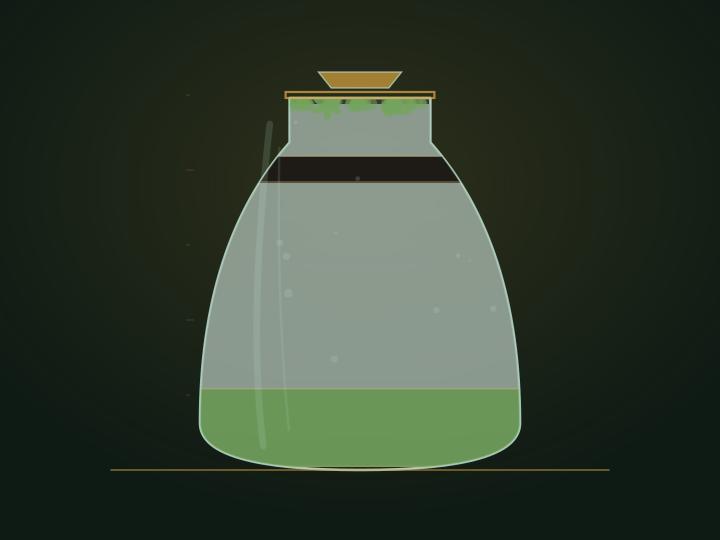
Stratum by stratum
- Drainage: 1 cm fine gravel, washed
- Filter: 0.5 cm charcoal
- Substrate: 4 cm coir-akadama blend, mounded at the bulb
- Cap: 1.5 cm mixed moss sods, one per quadrant
- Container form
- Jar & caseteardrop
- Settled height
- 26 cm
- Working volume
- 2.6 L
- Light demand
- Medium
- Humidity band
- High
- Difficulty
- Intermediate
- Days to establish
- 35 days
Stratum by stratum
-
Thin gravel base
Just 1 cm of washed fine gravel. In a hanging vessel you want the water column as short as possible so the moss at the top of the bulb is never sitting under a head of water.
-
Charcoal seam
0.5 cm charcoal, spread evenly through the widest part of the bulb where it does the most work. Tilting the vessel while you pour is normal — settle it with a bubble level before you go further.
-
Mounded substrate
Four centimetres of coir-akadama blend, built up highest at the narrow neck and lowest at the open mouth. This mound is what stops the top of the planting from waterlogging while the bottom drains.
-
Quadrant moss sods
Divide the surface into four quadrants and seat one moss species in each. Feather moss at the top of the mound, pillow moss at the base, spikemoss on the sides. Mixed species read as a miniature landscape rather than a single green mass.
-
Hanging and settling
Thread the hanging loop before you plant, not after — a fully loaded teardrop is heavy and awkward. Hang it so the lowest point of the glass is clear of the wall, and mist from the side, never from above.
Growing on
Feather moss is the most demanding species here and sits at the top of the mound precisely because it wants the fastest drainage. Spikemoss is the most forgiving and will tolerate brief dryness. Miniature ivy will try to climb out through the mouth; pinch it back when it reaches the rim or it will shade the moss below it. Pillow moss at the base holds the most water and acts as a sponge for the whole vessel, so check it first when deciding whether to mist.
Upkeep rhythm
Weigh the orb in your hand every week — a hanging terrarium gives you no visual water-level cue, so the weight test is the only reliable one. Mist the inside walls once a week, more often in summer. Every two months take the orb down, check the cork is not cracked, and rotate it a quarter turn so both sides get equal light. Remove any moss that has gone black at the base; in a hanging vessel that rot will run upward faster than in a jar.