Closed · 32 cm · 75 days to establish
Three-Strata Bottle Garden: Planting Through a 4 cm Neck
A narrow-necked demijohn is the classic Victorian bottle garden and still the most demanding closed build you can attempt. The neck is your only access point, which means every layer must be poured and every plant seated with tools alone. In exchange you get the deepest, most layered display in this collection — three visible terraces seen through curved glass.
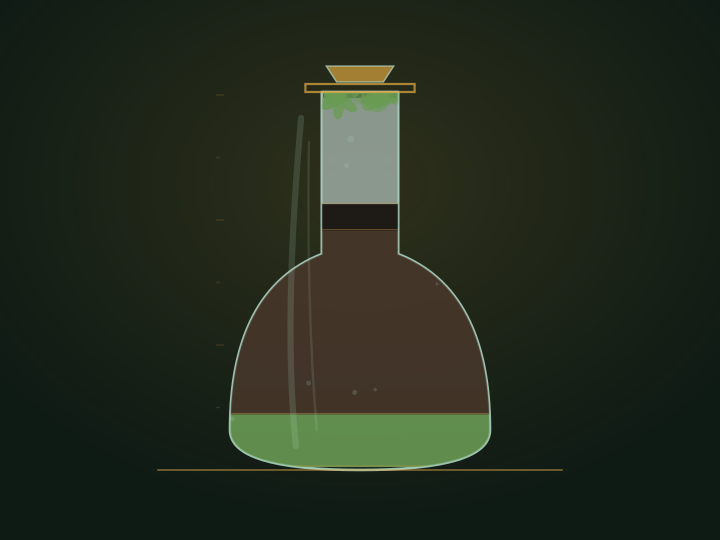
Stratum by stratum
- Drainage: 4 cm washed gravel, layered by size
- Filter: 1 cm charcoal, then 0.5 cm sand
- Substrate: 7 cm coir-peat mix, terraced in three steps
- Cap: 2 cm moss, thicker at the neck
- Container form
- Closedbottle
- Settled height
- 32 cm
- Working volume
- 3 L
- Light demand
- Medium
- Humidity band
- Sealed loop
- Difficulty
- Advanced
- Days to establish
- 75 days
Stratum by stratum
-
Graded gravel floor
Four centimetres of washed gravel poured through a funnel tube, coarse grade first and finer on top. Grading the sizes stops the upper layers silting into the lower ones, which in a bottle you can never correct by hand.
-
Charcoal and sand seal
One centimetre of charcoal followed by 0.5 cm sand, both poured slowly to keep the line level. A crooked seam in a bottle is visible from every angle and cannot be fixed after the plants go in.
-
Terraced substrate
Seven centimetres of coir-peat mix built into three terraces using a bamboo cane to tamp each step. Terraces give the bottle depth and, more practically, stop water from pooling in one place at the base.
-
Seating plants with forceps
Use 40 cm forceps to lower each plant root-first, then a wire hook to firm the substrate around it. Work from the back terrace forward. The earth star goes at the front where its rosette is fully visible; the fern at the back.
-
Moss cap and first seal
Drop moss in small clumps and position them with the hook, thicker near the neck where humidity is highest. Mist with a long-nozzle sprayer aimed at the glass, cork it, and leave it in medium light for a week before the first inspection.
-
The 75-day establishment
A bottle takes longer to stabilise than a jar because the neck restricts gas exchange. Expect condensation for the first three weeks. Judge the build at day 75, and top up water only through the funnel tube.
Growing on
Ivory fern and earth star both need more light than pure moss, so place the bottle in medium rather than low light and rotate it a quarter turn every week — curved glass focuses light unevenly and will scorch one side while the other etiolates. Sheet moss is the humidity reservoir; if it dries silver-green at the neck, the bottle needs water. Soleirolia will reach the terraces and fill the gaps between them, which is what you want, but pinch it back whenever it starts to obscure the earth star.
Upkeep rhythm
This is the highest-maintenance sealed build in the collection because you cannot reach anything. Use the wire hook to retrieve fallen leaves, which is why you should always keep one long enough to reach the back terrace. Water with a funnel tube, 15 ml at a time, only when the moss at the neck has lost its gloss. Open the cork for one hour every three weeks. If you see mould, do not panic and empty the bottle — open the cork for a day, remove the affected plant matter with the hook, and let the balance re-establish.