Closed · 17 cm · 30 days to establish
The Sealed Mason Jar: A 1.9 L Closed Moss Terrarium
A screw-band mason jar is the cheapest reliable closed terrarium on earth, and it is unforgiving in exactly one way: you cannot reach inside it. That single constraint drives every decision below. This build establishes a self-watering loop in roughly 30 days and then needs almost nothing from you for years.
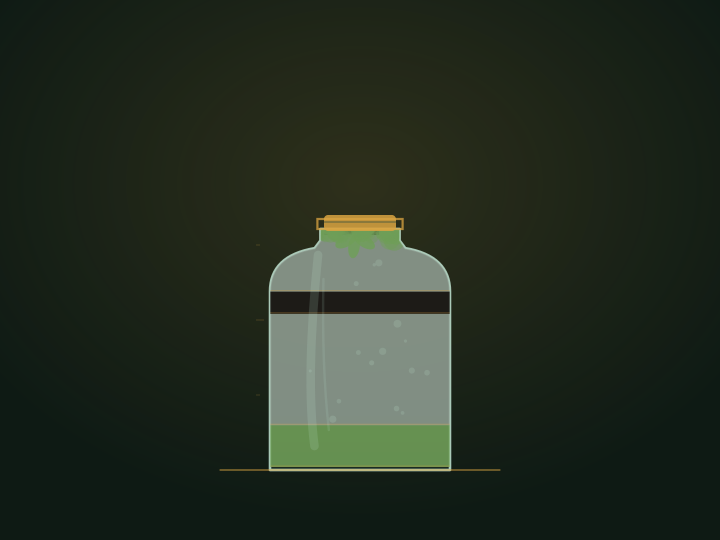
Stratum by stratum
- Drainage: 2 cm rinsed pea gravel (4-6 mm)
- Filter: 0.8 cm horticultural charcoal
- Substrate: 4 cm coir + akadama fines (70/30)
- Cap: 1.5 cm shredded sphagnum
- Container form
- Closedmason
- Settled height
- 17 cm
- Working volume
- 1.9 L
- Light demand
- Medium
- Humidity band
- Sealed loop
- Difficulty
- Beginner
- Days to establish
- 30 days
Stratum by stratum
-
Drainage floor
Pour 2 cm of rinsed 4-6 mm pea gravel through a paper funnel. Rinse until the water runs clear — dusty gravel turns the reservoir into grey mud that never settles and reads as a permanent fog on the glass.
-
Charcoal filter
Add a thin 0.8 cm band of horticultural charcoal, not barbecue briquettes. This layer adsorbs the sulphur compounds that decaying moss releases in a sealed vessel, which is the difference between a jar that smells like a forest floor and one that smells like a swamp.
-
Living substrate
Mix coir with akadama fines at roughly 70/30 and press 4 cm in, sloping it toward the back so the front glass stays legible. Tamp it with the flat of your hand, not a tool; you want structure, not compaction.
-
Moss cap and planting
Lay shredded sphagnum at 1.5 cm, then seat cushion moss with long tweezers, pressing each clump until it contacts the substrate. Pocket the button fern at the rear third and tuck its crown slightly above the moss line.
-
First mist and seal
Mist the walls, not the moss, until droplets run down. Close the band finger-tight and leave the jar in medium light for 72 hours untouched before you judge anything.
Growing on
Cushion moss wants to stay damp but never soaked; in a sealed jar it stays that way on its own once the loop closes. Button fern is the sensitive one — it will scorch if the jar sits in direct afternoon sun and rot if its crown is buried. Keep the crown above the moss line and give the jar 2-3 hours of gentle morning light at most. Bonsai growers describe this same crown-exposure rule for ferns and it transfers directly.
Upkeep rhythm
After the first month the jar should fog in the morning and clear by mid-day. That cycle is the health indicator. If fog never clears, open the band for two hours; if the glass never fogs at all, add 5 ml of water down the wall. Trim moss that touches the lid — contact with condensate is where mould starts. Expect one 10-minute session per month.