Closed · 20 cm · 60 days to establish
Microfauna Jar: A Closed Terrarium With a Cleanup Crew
Every sealed terrarium eventually accumulates dead plant matter, and in a sealed vessel that matter has nowhere to go. This build solves it biologically: a culture of springtails turns the jar into a self-cleaning system. It is the most demanding build in this collection because you are managing a population, not just a plant.
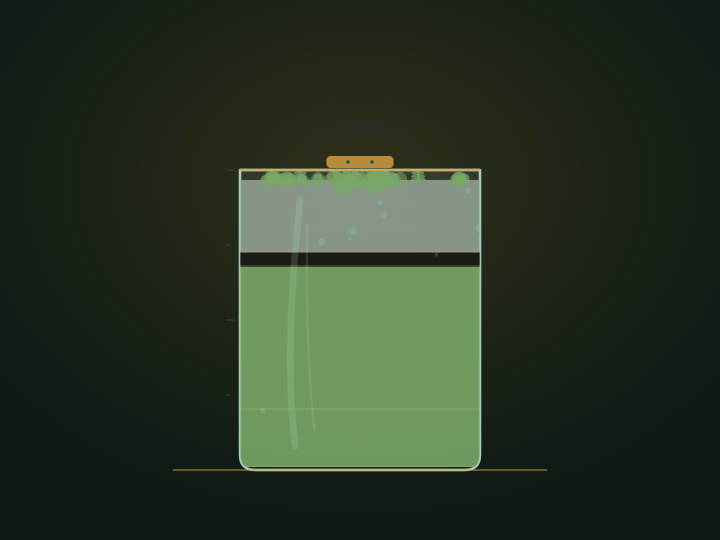
Stratum by stratum
- Drainage: 2.5 cm akadama, medium grain
- Filter: 0.5 cm charcoal
- Substrate: 5 cm sphagnum peat, milled, packed wet
- Cap: 2 cm live sphagnum heads
- Container form
- Closedcylinder
- Settled height
- 20 cm
- Working volume
- 2.3 L
- Light demand
- Low
- Humidity band
- Sealed loop
- Difficulty
- Advanced
- Days to establish
- 60 days
Stratum by stratum
-
Akadama drainage
2.5 cm of medium akadama. The granular clay holds water in its pores and releases it slowly, which suits sphagnum far better than a gravel sump that alternates between bone dry and flooded.
-
Charcoal seam
0.5 cm charcoal, and no more. In a springtail jar an over-thick charcoal layer removes the dissolved organics the culture actually feeds on, and the population crashes within a month.
-
Packed peat base
Milled sphagnum peat, 5 cm, packed wet and firm. Sphagnum grows from the top down and dies from the bottom up; the peat you pack today is the substrate the moss will still be standing on in three years.
-
Live sphagnum heads
Lay live sphagnum heads 2 cm deep, packed shoulder to shoulder with no gaps. This is the substrate the sundew and oakleaf fig will root into — not the peat.
-
Inoculation
Tip a springtail culture onto the moss surface and do not water it in. They will distribute themselves as the surface dries. Add a 20 ml syringe of water down the wall if the jar fogs constantly for more than three days.
-
The 60-day rule
Springtails need time to establish a breeding population before they can handle fallen leaves. For the first two months, remove dead matter by hand exactly as you would in a sterile jar. Only after day 60 can you let them work.
Growing on
Live sphagnum is the engine of this build: it acidifies its own surroundings, holds many times its weight in water, and provides the humid microclimate the sundew needs. Round-leaved sundew is included deliberately as a monitor — it will not survive on tap water and will decline within weeks if the water you add is hard. Use rainwater or distilled water only, and if the sundew browns from the tips inward, that is your signal. Oakleaf creeping fig will climb the glass if you let it and is easy to pinch back.
Upkeep rhythm
Let the springtails work. Once established, they consume fallen leaves, algae film on the glass and mould before it becomes visible, which is why a mature microfauna jar can go years without intervention. Open the vented cork every two weeks for an hour of air exchange and inspect the moss surface with a magnifier for mite outbreaks. If you see springtails clustering on the glass above the moss line, the substrate is waterlogged — leave the cork open for a full day.